The 2026 Outside Provider Safety Report
How out-of-school programs track the adults in the room, and what it costs when they don't.
Arielle Hammond, Ed.D., lead author. Published by enrops, 2026. enrops is disclosed as the sponsor.
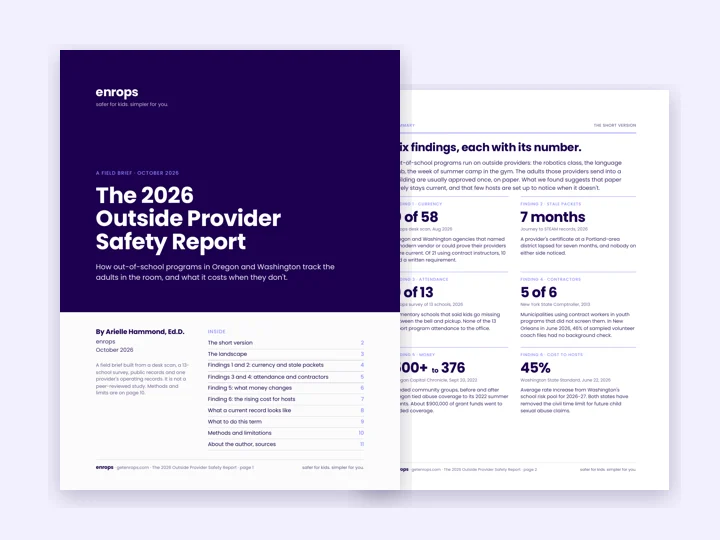
How out-of-school programs track the adults in the room, and what it costs when they don't.
Arielle Hammond, Ed.D., lead author. Published by enrops, 2026. enrops is disclosed as the sponsor.
Every number below carries its source. Nothing here comes from a press release or a vendor estimate.
0 of 58.
In a desk scan of 58 Oregon and Washington agencies, none named a modern vendor for tracking outside providers or could show that its providers' paperwork was current. Of the 21 that use contract instructors, 10 had a written requirement.
enrops desk scan, Aug 2026
Seven months.
One of our own certificates at a school district lapsed for seven months, and nobody on either side noticed.
The author's operating records, 2026
7 in 10.
In our 2026 survey of host elementary schools, 7 in 10 said kids go missing between the bell and pickup, and none report attendance to the office.
enrops survey of elementary schools, 2026
500+ to 376.
When Oregon required abuse coverage for its 2022 summer grants, funded community groups fell from more than 500 to 376.
Oregon Capital Chronicle, Sept 20, 2022
0 of 35.
None of 35 applications pre-screened by the ESD association had the required coverage.
Oregon Capital Chronicle, June 7, 2022, reporting the ESD association's pre-screen
About $900,000.
63% of the 364 grantee organizations had to buy added coverage, about $900,000 of grant funds in all; the median was $2,500.
OregonASK report to the Legislature, Jan 24, 2023
5 of 6.
Five of six New York municipalities that used contract workers in youth programs did not screen them; 128 workers in all.
New York State Comptroller audit, 2013
46%.
No background check was found in 46% of sampled New Orleans volunteer coach files.
New Orleans Office of Inspector General, June 2026
45%.
Washington's school risk pool raised rates an average 45% for 2026-27.
Washington State Standard, June 22, 2026
No time limit.
Oregon HB 3582 (2025) removes the civil time limit for future child sexual abuse claims; Washington HB 1618 (2024) does the same for acts after June 6, 2024.
Oregon Legislature; Washington session law
7.8 million.
Children in after-school programs in the US; 24.6 million more would enroll if a program were available to them.
America After 3PM, 2020
The pattern is consistent. Hosts already wrote requirements. The paperwork goes stale between terms. When requirements tighten without a way to prove them, programs and kids are the ones that drop out.
Sources: Oregon Capital Chronicle, Sept 20, 2022 · Oregon Capital Chronicle, June 7, 2022 · OregonASK report to the Legislature, Jan 24, 2023 · NY State Comptroller, 2013 · NOLA OIG, June 2026 · Washington State Standard, June 22, 2026 · OLIS HB 3582 · Washington session law HB 1618 · KUOW · NJ101.5 · Afterschool Alliance
enrops. (2026). The 2026 Outside Provider Safety Report: How out-of-school programs track the adults in the room, and what it costs when they don't. https://getenrops.com/research
Copy citationAPA style. Quote any finding on this page with its original source.
The full findings with every source, the methods in detail, and the questions a host or funder can ask of its own provider list.
Arielle Hammond is available for panels, keynotes and press on outside-provider safety. A former principal who approved enrichment vendors and now sends the packets as a provider, she speaks to both sides of the table. Use the contact form.
Associations and risk pools can co-publish the next study or sponsor the research. Write to hello@enrops.com.
About the report
The 2026 Outside Provider Safety Report looks at how out-of-school programs track the adults in the room, and what it costs when they don't, with every number tied to its original source.
About the author
Arielle Hammond, Ed.D., is a former K-5 principal who led schools for over a decade and the founder of enrops. She runs a youth enrichment organization across 93 school and community sites.
Press contact: hello@enrops.com

The 2026 report is a first look. The planned Phase 1 study widens it: a broader scan of host requirements, a short survey of coordinators and the offices that own the rule, and a provider survey.
To take part as a host, funder or association, write to hello@enrops.com.
Hosts, funders and associations can add their organization to the 2027 study. We will send the short survey when it opens and the preliminary findings on March 1, 2027.
There is no single rule that covers every enrichment provider. What a provider needs is what each host wrote into its own agreement or packet, plus any condition a funder attaches to its money. Some school districts also run their own fingerprint checks on contractors, and those stay with the district.
That is your own office's call; there is no single standard for enrichment. The lines hosts ask us to show are a screening status for every adult, abuse-prevention training, proof of insurance with the abuse line and its limit, and a signed agreement. In our scan, 10 of 21 agencies that use contract instructors had a written requirement (enrops desk scan, Aug 2026). The harder part is knowing it is still current mid-term.
Only if a host or funder asks for it. When Oregon attached abuse coverage to its 2022 summer grants, 63% of the 364 grantee organizations had to buy added coverage, a median of $2,500 (OregonASK, Jan 24, 2023).
Mostly by collecting a packet once and filing it. In our desk scan, 0 of 58 Oregon and Washington agencies could show their providers' paperwork was current (enrops desk scan, Aug 2026).
Oregon HB 3582 (2025) removes the civil time limit for future child sexual abuse claims. Washington HB 1618 (2024) does the same for acts after June 6, 2024.
enrops published it and is disclosed as the sponsor. The lead author, Arielle Hammond, founded enrops and runs an enrichment company of her own, whose records are labeled as such.
The findings, the sources and the questions to ask of your own provider list, in one report.
Sources: Oregon Capital Chronicle (2022); OregonASK (Jan 24, 2023); Washington State Standard (June 22, 2026); enrops desk scan (Aug 2026); enrops survey of elementary schools (2026).